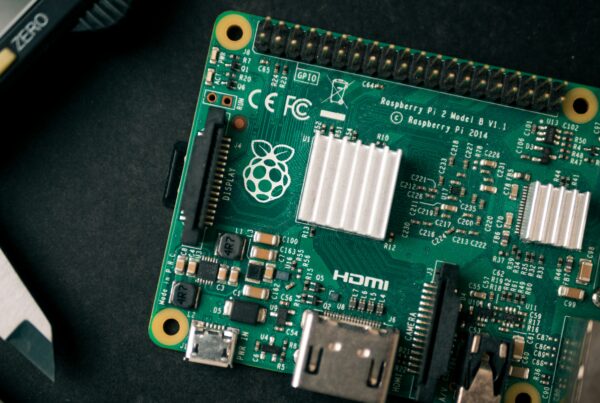


Photo by Homa Appliances on Unsplash
Retrofitting Legacy Machines for IoT Without Ripping Out the PLC
You can add IoT monitoring and remote control to a machine that’s older than some of your engineers, and you very rarely need to touch its existing PLC to do it. The retrofit pattern that actually works is additive: an edge gateway reads what the machine is already doing, over RS-485/Modbus, CAN, or direct digital and analogue signals, and publishes it in a modern format, while the original control system keeps running exactly as before.
Why “replace the machine” is usually the wrong answer
Replacing a working, paid-off machine to get connectivity is rarely justified by the numbers. The mechanical and control system are often perfectly sound; what’s missing is a way to get data off it without a technician manually logging readings. That’s a data and connectivity problem, not a machinery problem, and it has a much cheaper fix.
What a retrofit actually involves
1. Identify what the machine already exposes.
Most legacy industrial equipment already communicates in some form, a Modbus RTU register map on an RS-485 line, a CAN bus carrying status frames, or simple discrete signals (run/stop, fault, limit switches) on relay contacts. This existing interface is the retrofit’s entry point, and it means no changes to the machine’s own control logic.
2. Wire the gateway in alongside the existing system, not instead of it.
An edge gateway with RS-485, CAN and 12+ digital/analogue I/O, the ATLAS configuration, can typically connect in parallel with the existing PLC or controller: tapping the same RS-485 bus, reading the same CAN frames, or wiring into spare relay contacts and analogue outputs. Nothing about the original control loop needs to change.
3. Normalise and publish the data.
Once the gateway is reading real signals, it converts them into named, typed values and publishes them over MQTT or OPC UA, the formats modern SCADA, historians and dashboards expect. This is the step that turns “a machine with a serial port” into “a monitored, reportable asset.”
4. Add remote visibility without adding risk.
With Wi-Fi, BLE and LTE built into the gateway, alarms and status can reach a phone or dashboard without any change to the plant network’s exposure, the gateway is the only thing communicating externally, and everything else on the machine stays as isolated as it always was.
What this buys you, concretely
- Downtime alerts before a full stoppage, from monitoring pressure, temperature, vibration or cycle counts that were previously only visible to someone standing next to the machine.
- A usage and performance history that didn’t exist before, useful for maintenance planning, warranty discussions and capacity decisions.
- A foundation for service contracts and SLAs, since remote monitoring data is what makes “we’ll know before it fails” a credible commitment rather than a slogan.
- A retrofit that doesn’t touch safety-rated control logic, because the gateway reads and reports; it doesn’t need to intervene in the machine’s own control loop to add this value.
When it isn’t this simple
Some legacy equipment genuinely has no usable interface at all, no serial port, no spare I/O, nothing but mechanical indicators. In those cases the retrofit still starts with the same question (what does the machine already expose, even mechanically, a pressure gauge, a limit switch), but expect to add a sensor or two rather than relying purely on existing signals. It’s still almost always cheaper and less disruptive than a machine replacement.

FAQ´S
Does retrofitting a legacy machine void its warranty or certification?
Reading existing signals in parallel, tapping an RS-485 line, wiring into spare I/O, generally doesn’t alter the machine’s certified control function, but always check the specific equipment’s documentation and consult the manufacturer if the machine is still under warranty.
How long does a typical single-machine retrofit take?
For equipment with an existing communication interface (Modbus, CAN, or simple relay signals), wiring and initial data mapping is often completed in a day; refining alarms and dashboards typically takes longer, but doesn’t block getting basic visibility live.
Can one gateway monitor more than one legacy machine?
Yes, provided the I/O and bus capacity covers the combined signal count, RS-485 in particular supports multiple devices on a single bus, so several older machines with Modbus interfaces can often share one gateway.