
Photo by Louis Reed on Unsplash
From Prototype to Production Without Re-Platforming: The ATLAS Approach
Most industrial IoT pilots die at the same point: the prototype works, everyone’s happy, and then someone asks what it takes to deploy it across 40 more machines. The honest answer, on most dev-kit-based projects, is “start again”, different enclosure, different I/O, different firmware, sometimes a different processor. SENSBLUE ATLAS is designed specifically to avoid that cliff: the board you prototype on is the board that ships to production, unchanged.
Why re-platforming happens so often
Prototyping hardware and production hardware optimise for different things, and teams usually don’t notice the gap until it’s expensive:
– Dev kits use breadboard-friendly connectors (jumper wires, headers) that don’t survive vibration, dust or a DIN-rail cabinet.
– Dev kits skip isolation and surge protection, because it’s not needed on a bench, until the same board is wired into a cabinet next to a variable-speed drive.
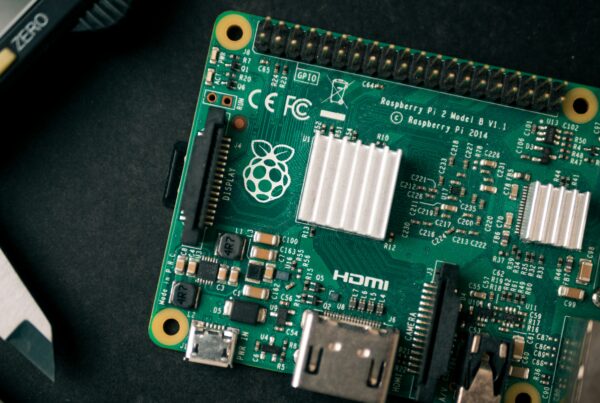
– Prototypes are built on whatever’s in stock, often a general-purpose single-board computer rather than one rated for -10 °C to +60 °C operation.
– Firmware and wiring assumptions get baked in early, so moving to industrial-grade hardware later means re-wiring, re-testing, and re-validating everything.
Each of those, individually, is a reasonable shortcut for a two-week proof of concept. Together, they mean the “successful pilot” was never actually a step towards production, it was a different project wearing the same name.
What “zero platform change” looks like in practice
ATLAS is built on a Raspberry Pi Compute Module 4, the same industrial-grade processor family used across countless commercial deployments, but wrapped in a DIN-rail enclosure with:
- 12 digital I/O, 6 analogue I/O, 2 relay outputs and 2 load-cell inputs on locking pluggable terminal blocks, the same connectors from bench test to cabinet install.
- Galvanic isolation and surge protection on the field-side I/O, rated from day one for the electrical noise of a production environment.
- An operating range of -10 °C to +60 °C, so a unit validated on a desk performs identically in an unheated plant room.
- RS-485, CAN and dual independently-managed Ethernet, so the protocol integration work done during the pilot carries over exactly.
- Wi-Fi, BLE and LTE built in, meaning connectivity doesn’t need to be re-engineered when a device moves from a well-connected lab to a remote site.
Because the hardware doesn’t change, the software stack doesn’t have to either: Node-RED flows, MQTT topic structures and OPC UA mappings built during the pilot deploy directly to production units.
A practical route from one unit to fifty
1. Prototype on a single ATLAS unit, wired exactly as it would be in the field, real sensors, real cabinet, real network conditions where possible.
2. Validate the data and control logic using the same Node-RED and MQTT stack that ships on production units, so nothing gets rebuilt later.
3. Order production units to the same specification. There’s no separate “industrial version” to requalify, it’s the same board.
4. Roll out in batches, using the gateway’s remote access (via LTE or the customer’s network) to monitor and adjust configuration without a site visit for every unit.

FAQ´S
Does moving from prototype to production with ATLAS require new firmware?
No, the same software stack (Node-RED, MQTT, the underlying OS) runs unchanged on both prototype and production units, since it’s the same hardware platform.
What's the biggest hidden cost of the traditional prototype-then-redesign approach?
Re-validation time. Every change to I/O, enclosure or processor typically means re-running EMC, environmental and functional tests, which routinely adds months to a rollout, even when the underlying logic hasn’t changed.
Is ATLAS suitable for a single pilot line, or only for large rollouts?
Both. The point of “zero platform change” is that a single-unit pilot and a fifty-unit rollout use identical hardware, so there’s no minimum scale required to get the benefit.