
Edge Gateway vs PLC: Which One Actually Fits Your Line?
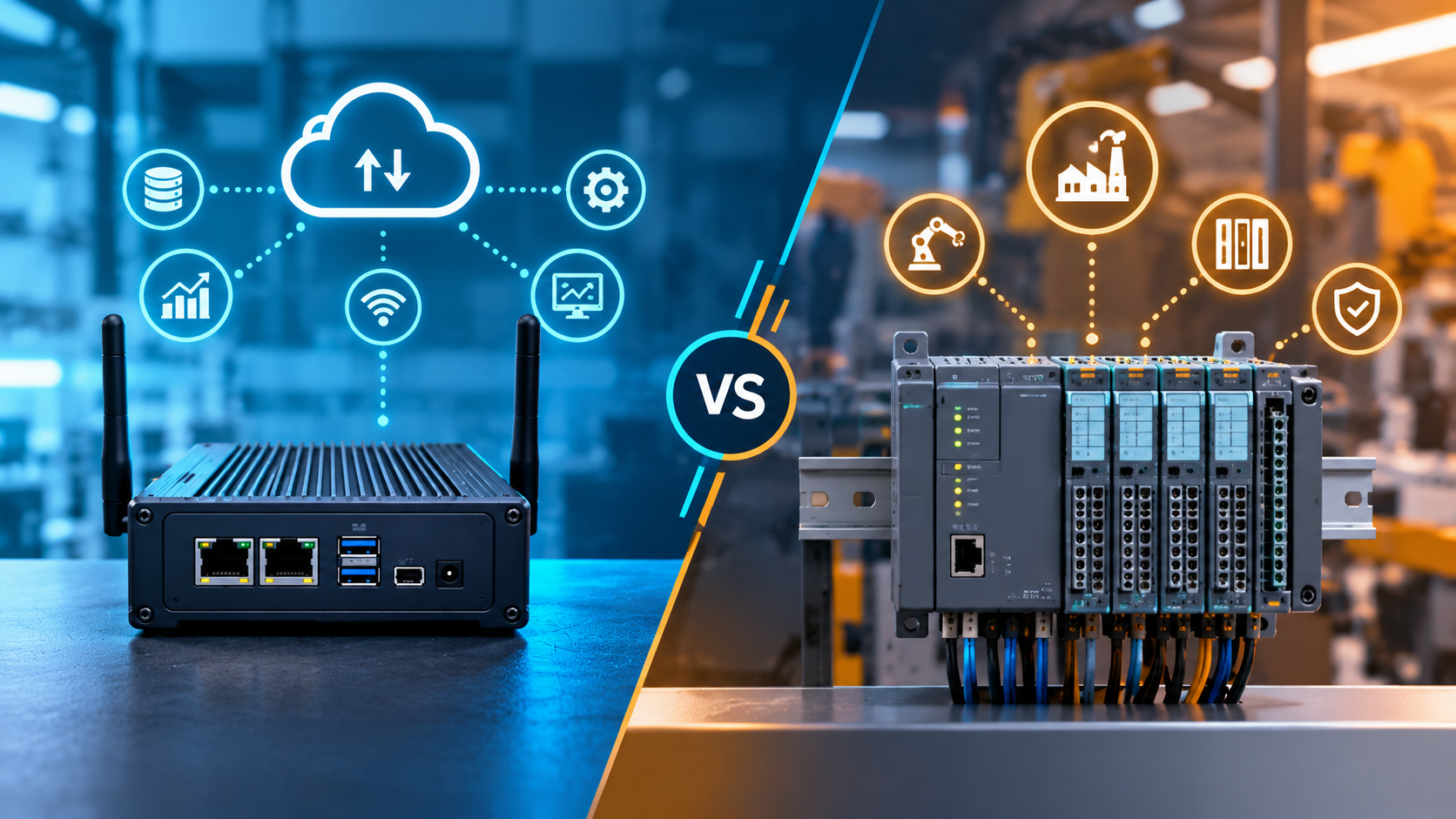
Short answer: a PLC is built for deterministic, safety-critical control; an edge gateway is built for connectivity, data standardisation and flexible I/O, and can often run lighter control logic too. Most modern deployments use both, the PLC keeps doing what it’s certified for, and the gateway handles everything the PLC was never meant to do: MQTT, OPC UA, cloud dashboards, remote alarms and protocol bridging.
Choosing between them, or deciding how to combine them, comes down to three questions.
1. What kind of control does the job actually need?
PLCs run on a fixed scan cycle with hard real-time guarantees, and they’re certified for safety functions under standards like IEC 61508/61511. If you’re controlling a press, a robot arm, or anything where a control loop failing has physical safety consequences, that certification and determinism matter, and a gateway is not a substitute.
If the job is monitoring pressure, temperature or status, switching a relay on a schedule, or triggering an alarm when a threshold is crossed, that’s well within what an edge gateway can do, and it can do it while also publishing the same data to a dashboard, which a traditional PLC generally can’t do without an add-on module.
2. How much does connectivity matter?
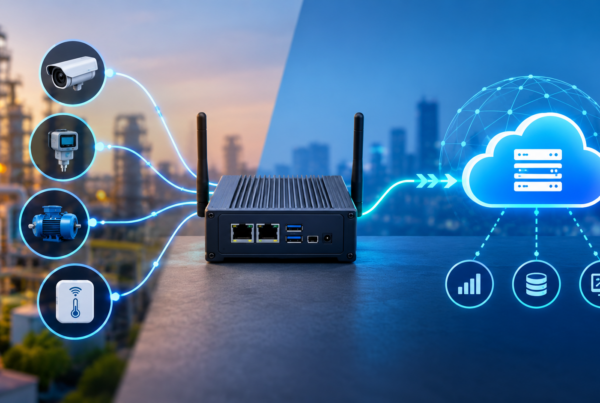
This is where the comparison usually resolves itself. PLC programming environments were not designed with MQTT, OPC UA or REST APIs as a first-class concern, connecting a PLC to the cloud typically means an additional gateway device anyway. An edge gateway like SENSBLUE ATLAS is built the other way round: RS-485, CAN and dual Ethernet on the field side; MQTT, OPC UA and cloud connectivity (Wi-Fi, BLE, LTE) on the system side, in one box.
If the primary goal of the project is “get this data somewhere useful, reliably,” a gateway gets there faster and with far less integration work than adapting a PLC-centric architecture.
3. What does the total cost of ownership actually look like?
PLC hardware, licensed programming software, and the specialist engineering time to write ladder logic or structured text are not cheap, and changes to the program usually require that same specialist. A gateway running Node-RED or a similar flow-based tool can often be reconfigured by a broader range of engineers, and the hardware itself, built on a Raspberry Pi Compute Module 4 in ATLAS’s case, sits at a materially lower price point than an equivalent PLC with comparable I/O and connectivity.
None of this means “replace your PLCs.” It means: don’t ask a PLC to do a gateway’s job, and don’t ask a gateway to do safety-critical control.
A practical split that works
In most retrofits we see, the arrangement looks like this:
- PLC keeps running the certified control loop it was already running, untouched.
- Edge gateway reads the PLC’s Modbus or RS-485 output, adds its own direct sensor readings (temperature, pressure, vibration, load cell), and publishes the combined picture via OPC UA or MQTT to SCADA, a historian, or a cloud dashboard.
- The plant floor sees no change. The new visibility is additive, not disruptive.

FAQ´S
Can an edge gateway replace a PLC entirely?
For simple, non-safety-critical control, monitoring, alarming, scheduled switching, yes, in many cases. For certified safety functions, no.
Do I need to reprogram my PLC to add a gateway?
Usually not. The gateway typically reads existing PLC data over Modbus/RS-485 or via I/O it wires into directly, without touching the PLC’s own logic.
Which is cheaper long-term, a PLC or an edge gateway?
For connectivity and monitoring tasks specifically, a gateway is typically cheaper to buy, deploy and reconfigure over time, because it’s built for that job rather than adapted to it.