

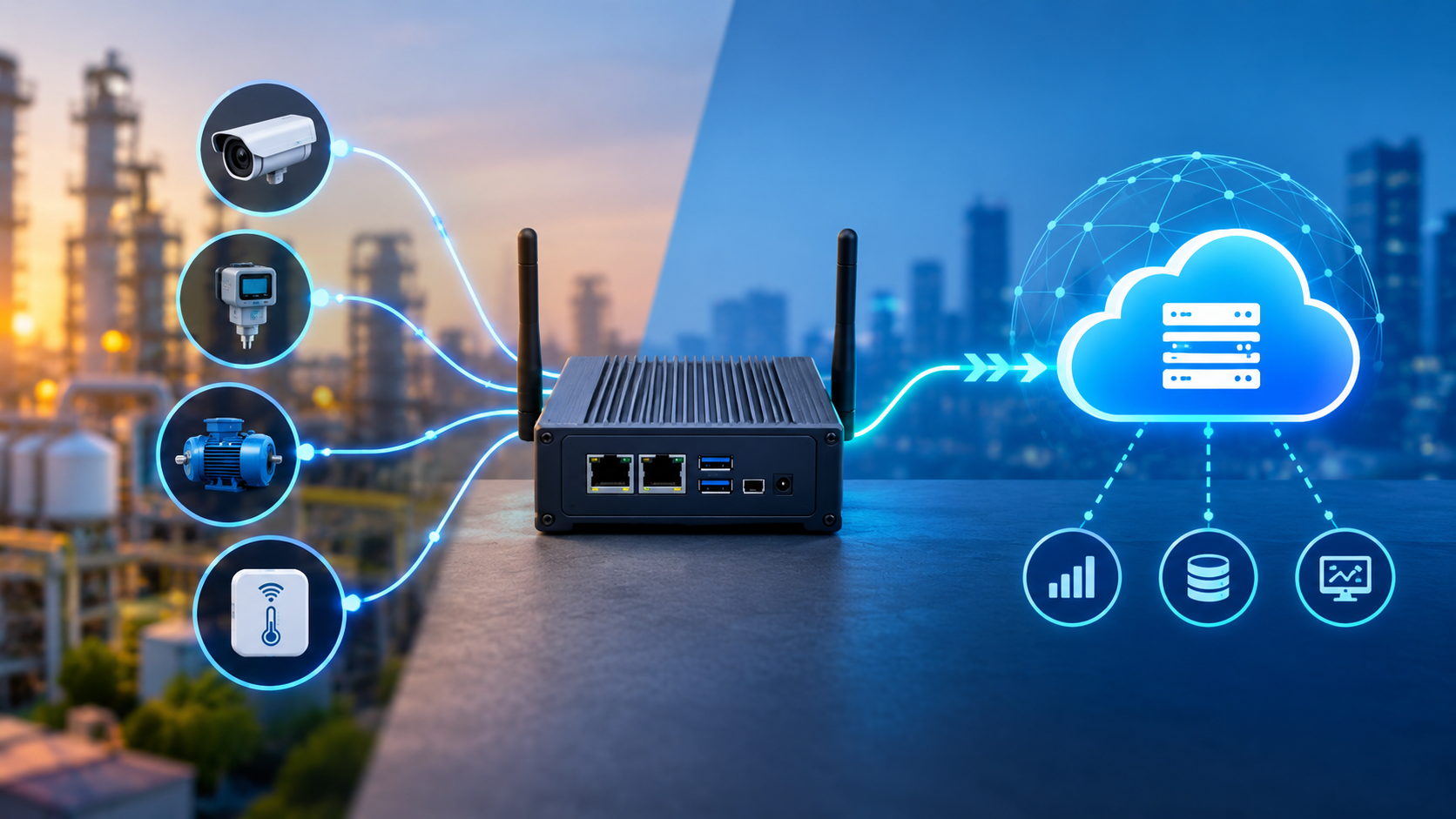
What Is an Edge Gateway?
An edge gateway is a piece of hardware that sits between your field devices, sensors, actuators, motors, meters and the systems that process the data, such as SCADA platforms, cloud dashboards or maintenance software. It reads and controls I/O locally, runs logic without depending on a live internet connection, and then forwards standardised data upstream over Ethernet, Wi-Fi or LTE. In short: it does the translating so nothing else in your stack has to.
That definition sounds simple, and it should. The confusion around edge gateways usually comes from vendors bundling in extra marketing rather than the concept being genuinely complicated.
Why industrial teams need one?
Most production environments are a patchwork of equipment bought over 10, 15, sometimes 30 years. A CNC machine speaks one protocol, a legacy PLC speaks another, a modern flow meter speaks a third. None of them were designed to talk to each other, let alone to a cloud dashboard.
An edge gateway solves this by acting as a bridge where the physical and digital worlds meet:
- On the field side, it reads digital and analogue signals directly, or talks to devices over RS-485/Modbus or CAN.
- On the system side, it exposes that same data through modern, standard protocols, MQTT, OPC UA, HTTP, that any SCADA, historian or cloud platform can consume.
- In between, it can run control logic locally, so a lost internet connection doesn’t mean a lost process.
What separates a gateway from “just a small computer?
Plenty of teams have tried to build this with a bare single-board computer and some scripts. It usually works for a demo. It rarely survives six months on a factory floor. The difference between a gateway and a hobbyist board comes down to a handful of practical details:
- Industrial I/O, not breadboard wiring.
SENSBLUE ATLAS, for example, ships with 12 digital I/O, 6 analogue I/O and 2 relay outputs as standard, on locking pluggable terminal blocks rather than jumper wires. - A real operating temperature range.
ATLAS is rated from -10 °C to +60 °C, which covers most plant rooms, cabinets and unheated enclosures without extra cooling. - DIN-rail mounting.
It needs to live in an electrical cabinet next to contactors and breakers, not on a shelf. - Galvanic isolation on the I/O.
Protects the compute module from field-side transients. - A path to production.
A prototype built on generic hardware almost always needs a redesign before it can be deployed at scale. A proper edge gateway is designed so the same board goes from bench test to the production floor unchanged.
Where ATLAS fits?
SENSBLUE ATLAS is ATRONIA’s universal edge gateway, built around a Raspberry Pi Compute Module 4 (quad-core Cortex-A72) for the compute side, with 12 DIO, 6 AIO, 2 relays, 2 load-cell inputs, RS-485, CAN and dual independently-managed Ethernet ports for the field side. Wi-Fi, BLE and LTE are built in, so it can operate as a fully connected device without additional hardware. A 1.47″ IPS display with joystick navigation gives an engineer on-site instant feedback, IP address, connection status, alarms, without opening a laptop.
That combination is what “industrial edge gateway” should mean in practice: one board that can read a 4–20 mA sensor, switch a relay, talk Modbus to an old PLC, and publish everything over MQTT or OPC UA to any platform your team already uses.

FAQ´S
Is an edge gateway the same as a PLC?
No. A PLC is built primarily for deterministic control logic on a factory floor. An edge gateway is built primarily for connectivity and data standardisation, though many, including ATLAS, can also run control logic locally. We cover the practical differences in [Edge Gateway vs PLC](./week-02-edge-gateway-vs-plc.md).
Does an edge gateway need a permanent internet connection?
No. A well-designed gateway keeps running control logic and logging data locally if the connection drops, and syncs once it’s back.
Can one gateway replace multiple pieces of legacy hardware?
Yes, particularly for signal converters, protocol bridges, and simple data loggers. This is why many teams retrofit older equipment with a single gateway rather than replacing it.